--Beyond the Perimeter: Why High-Range Fog Cannons Are Essential for Effective Mine Dust Control and Safety
1. The Undeniable Imperative for Long-Range Dust Management
In open-pit and large-scale mining operations—from coal to iron ore and copper—the scale of the site often means that traditional, static dust control measures are insufficient. Dust generation is not confined to a single point; it is a dynamic, mobile problem originating from blasting zones, haul roads, vast stockpiles, and widely dispersed crushing and screening plants.
Failing to address dust comprehensively across these large areas leads to two critical failures: compromising worker health and safety due to high exposure to respirable crystalline silica (RCS), and failing to meet increasingly strict environmental air quality standards, risking operational shutdowns and punitive fines. This is where the strategic deployment of a High-Range Dust Suppression System (Fog Cannon) transitions from a desirable asset to a non-negotiable operational necessity.
2. The Limits of Conventional Methods in Large-Scale Mining
Before delving into the technical advantages of high-range cannons, it is crucial to understand why common methods fall short across a large mine footprint:
Water Trucks/Carts: While essential for haul roads, they are slow, labor-intensive, create temporary fixes, and consume astronomical volumes of water. They cannot effectively treat vertical plumes from crushing or aerial dust from blasting.
Localized Spray Bars: Effective only at the precise point of emission (e.g., conveyor belts). Their throw distance is negligible, leaving adjacent areas like material drops, vehicle loading areas, and large storage bays completely untreated.
Chemical Binders (Crusting Agents): Excellent for long-term stockpile stabilization, but ineffective against immediate, high-volume dust generated during active processing or high winds.
The primary limitation of these methods is their lack of kinetic energy and reach. They cannot project the suppression medium (water mist) far enough or high enough to intercept the dust plume before it disperses across the wide mine environment.
3. Defining "High-Range": The Technical Edge
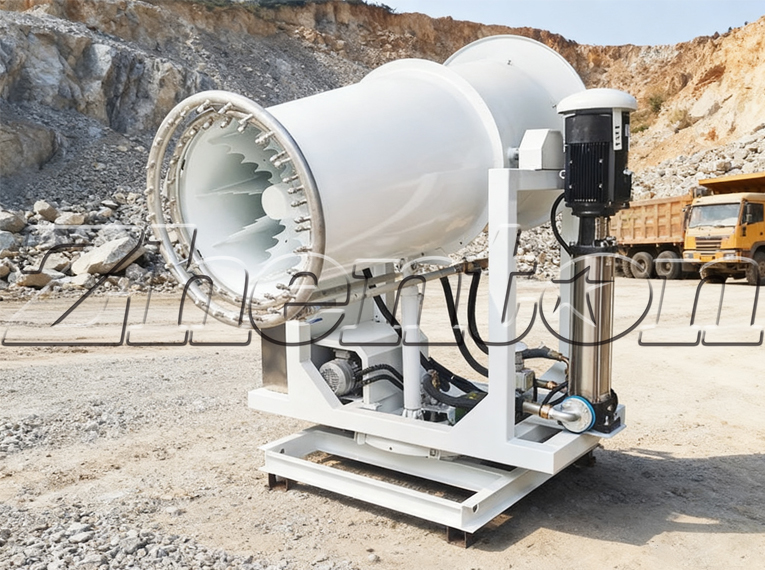
Our High-Range Fog Cannons are engineered specifically to overcome these distance limitations. "High-Range" refers not just to the throw distance, but to the system's capacity to deliver an optimally sized mist stream with high kinetic energy over a massive area.
3.1. Optimized Airflow and Fan Design:
The core of a high-range system is its Variable Pitch Axial Fan. This fan, powered by high-efficiency motors (IE4 class), generates a focused, high-velocity stream of air. This velocity is what gives the water droplets their maximum momentum, enabling a continuous, effective throw of up to 150 meters (depending on the model and wind conditions).
4. Critical Applications of Long-Throw Technology in Mining
The extended range of these systems allows for effective dust mitigation in applications unique to large mining sites:
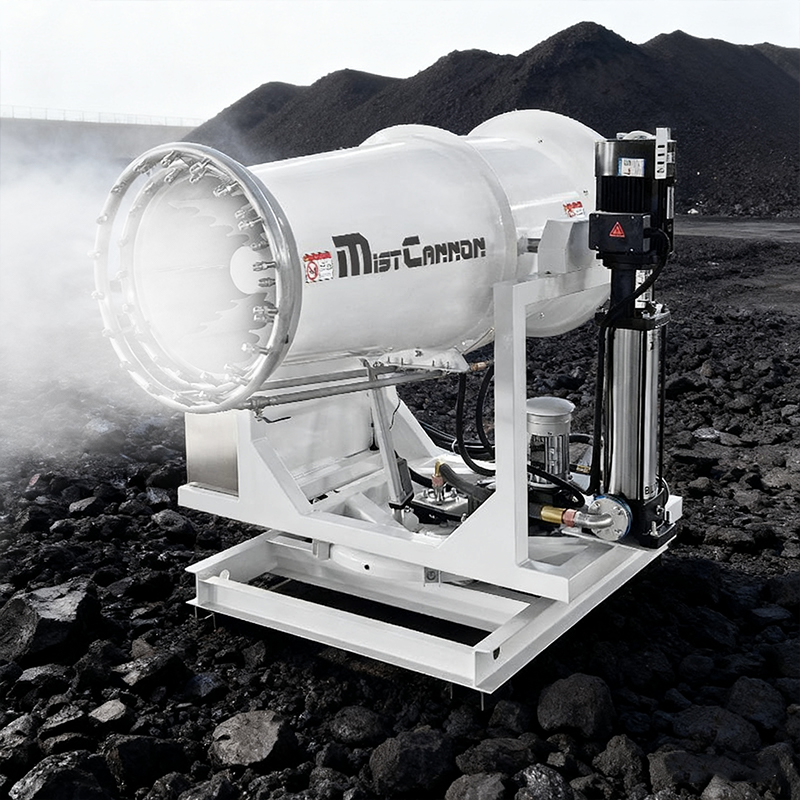
Stockpile Management and Wind Erosion: Large, open-air stockpiles (especially fine materials like concentrate or coal) are massive sources of fugitive dust, particularly during high winds. High-range cannons can be positioned along the perimeter, maintaining a low-volume surface wetting layer across the entire pile, preventing wind erosion and material loss without oversaturation.
Blasting and Muck Pile Treatment: Immediately following a blast, the muck pile remains a significant, non-moving source of dust and fumes. A high-range cannon can safely be placed outside the exclusion zone, providing preliminary dust mitigation before entry teams and machinery move in, improving safety protocols.
Haul Road Spot Treatment: While water trucks cover most roads, high-range units offer targeted treatment at key intersections or high-traffic areas where dust generation is chronic, reducing the need for constant water truck cycles and associated operational costs.
5. The Safety Dividend: Protecting Personnel from RCS
The most compelling reason for superior dust suppression is worker health. Inhalation of RCS is a known cause of silicosis and lung cancer. Mining regulations globally now mandate rigorous monitoring and exposure limits (e.g., TWA limits).
High-range systems directly contribute to lowering these exposure levels by:
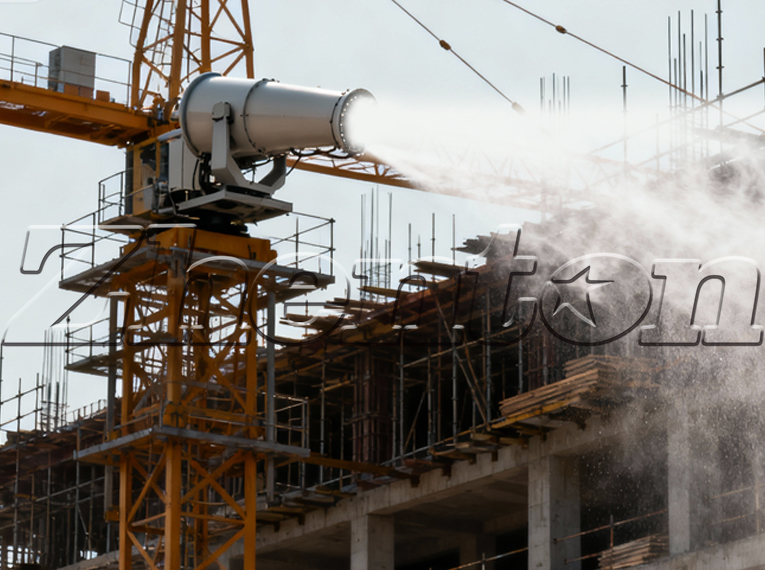
Creating Exclusion Zones: By capturing dust plumes before they reach worker-occupied control rooms or transport points, the cannon creates a protective barrier of clean air.
Targeting Mobile Sources: Many cannons can be trailer-mounted or placed on specialized, movable skids. This allows the suppression system to move with the dust source (e.g., following a primary crusher as it changes location), ensuring maximum capture efficiency exactly where it is needed, protecting the surrounding crews.
Q&A Segment 2: Operational Efficiency and Water Usage
Q: Does greater range mean greater water waste, and how much energy does a high-range cannon consume compared to a fleet of water trucks?
A: This is a common misconception. High-range suppression is fundamentally more efficient than bulk water application (trucks). A high-range cannon’s mechanism focuses on atomization, generating mist that maximizes the surface area-to-volume ratio of the water.
While a large water truck might spray hundreds of gallons per minute, a high-range cannon typically uses 15 to 40 gallons per minute (GPM) at full power, yet achieves a far superior dust capture rate because the water is delivered as effective micron-sized droplets, not runoff. The total energy required to run one high-efficiency cannon (e.g., 55kW) is significantly lower than the fuel, maintenance, and labor costs associated with operating a fleet of diesel-powered water trucks 24/7. The result is lower TCO and up to 50% water savings.
6. Smart Integration: Data-Driven Dust Suppression
Modern high-range systems move beyond simple on/off switches. They are integrated with smart technologies that maximize efficiency and compliance documentation:
Integrated Anemometers and Wind Vanes: Sensors monitor wind speed and direction in real-time. The system automatically adjusts its oscillation arc and spray density to compensate for wind drift, ensuring the mist always intercepts the downwind dust plume effectively.
Programmable Logic Controllers (PLC): The cannon can be pre-programmed for specific operating conditions (e.g., "Crusher Mode," "Stockpile Mode"). It can even be triggered remotely or automatically shut down in extreme weather conditions (e.g., high winds or freezing temperatures) to conserve resources and prevent damage.
Telemetry and Reporting: Data logging captures all operational parameters (flow rate, runtime, wind data). This provides verifiable proof of compliance for regulatory audits—a crucial element of modern environmental risk management.
7. The Economics of Proactive Dust Control
The investment in high-range suppression is easily justified by the financial risks of inadequate control:
Avoided Fines: Compliance failure can result in fines that quickly dwarf the cost of the equipment.
Increased Asset Life: By removing abrasive dust from the air, the system reduces wear and tear on adjacent heavy machinery, extending the life of engines, bearings, and filters.
Material Retention: Reducing wind erosion from stockpiles means less material loss, directly boosting revenue retention from high-value commodities.
Q&A Segment 3: Maintenance and Longevity in Mining Environments
Q: Given the abrasive, dusty nature of a mine, how is the long-term durability and maintenance of these high-tech systems ensured?
A: Our systems are designed with Marine-Grade Durability principles:
Material Science: All structural components, piping, and fasteners are made from high-grade stainless steel (304/316) and hot-dip galvanized steel, resisting the corrosive mix of dust, water, and regional contaminants.
Filtration: A multi-stage water filtration system is mandatory upstream of the high-pressure pump. This prevents fine particulates from the water source (e.g., reclaimed mine water) from reaching and clogging the micron-level nozzles.
Nozzle Design: We use high-wear, ceramic-inserted nozzles, which last significantly longer than plastic or brass in abrasive environments.
Enclosure: Motors and electronics are housed in IP66/IP67 rated enclosures, providing total protection against dust and jetting water. Routine maintenance is simplified, focusing mainly on filter cleaning and fluid checks, not structural repairs.
8. Conclusion: High-Range Systems Define Modern Mining Standards
High-range dust suppression is the signature technology of a modern, safety-conscious, and compliant mining operation. It is the only solution that combines the necessary reach, precision, and efficiency to manage dust generation across the entire, dynamic mining footprint. Investing in this technology is a direct investment in your workers' health, your operational continuity, and your license to operate sustainably.