Introduction: The Invisible Challenge in Cement Production
The cement industry is a cornerstone of global infrastructure, providing the fundamental materials required for urbanization and economic development. However, the manufacturing process—from limestone quarrying and clinker production to final packaging—is inherently dusty. Fugitive dust emissions in cement plants are not merely an aesthetic issue; they represent a significant operational, environmental, and regulatory challenge.
Fine particulates, specifically PM10 and PM2.5, are generated at almost every stage of the cement lifecycle. Without an effective mitigation strategy, these particles escape into the atmosphere, leading to severe health risks for workers, equipment abrasion, and heavy financial penalties from environmental agencies. To address this, modern cement facilities are moving away from traditional, inefficient watering methods toward advanced technology: the Dust Suppression Cannon.
As a manufacturer with over 16 years of experience, Zheng Tong Fan has engineered specialized dust suppression cannons designed to thrive in the high-heat, high-dust environments of cement production. This article provides a multi-dimensional look at how an integrated dust suppression system can transform air quality and operational efficiency in a cement plant.

Dimension 1: Understanding the Sources of Dust in Cement Facilities
To solve the dust problem, one must first map the sources. In a cement plant, dust generation is "fugitive," meaning it is not emitted from a single stack but escapes from various open and semi-enclosed areas.
Raw Material Handling and Storage: Limestone, clay, and additives are often stored in massive outdoor stockpiles. Wind erosion and the movement of front-end loaders create constant dust plumes.
The Crushing and Screening Phase: Breaking down large rocks into smaller aggregates releases high concentrations of fine dust at high velocities.
Conveyor Transfer Points: As material drops from one belt to another, the impact displaces air, carrying fine particulates upward and outward.
Clinker Cooling and Storage: The clinker production process involves extreme heat. As clinker cools and is moved to silos, the resulting dust is particularly abrasive and difficult to manage.
Loading and Shipping: Whether loading into bulk trucks or bagging for retail, the final stage of the process is a major source of airborne cement dust.
Dimension 2: The Science of the Dust Suppression Cannon
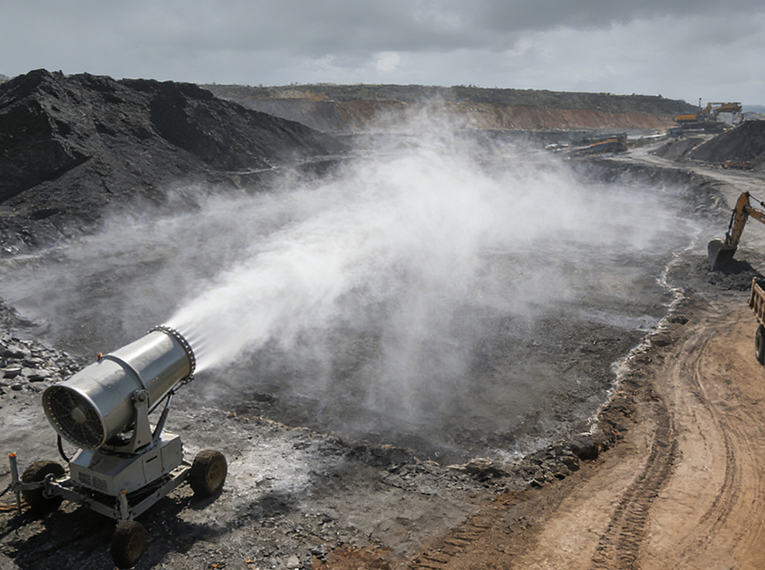
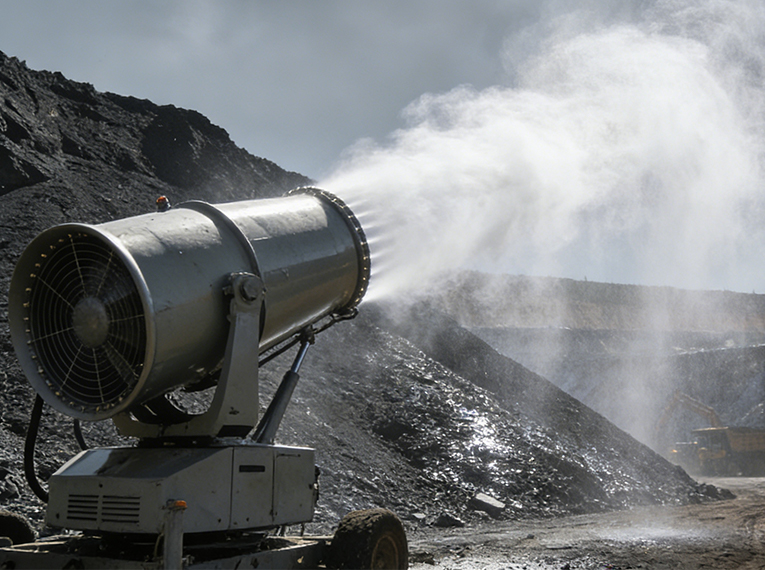
A Dust Suppression Cannon is not a simple fan; it is a precision-engineered instrument that utilizes the principles of fluid dynamics and atomization to clean the air.
The Principle of Atomization
The core of the system is the nozzle array. High-pressure pumps force water through specialized stainless steel nozzles, breaking the liquid into millions of microscopic droplets. In a cement environment, the droplet size is critical. If the droplets are too large (like a rain shower), the dust particles will simply ride the air currents around them.
Our dust suppression cannons are calibrated to produce droplets in the 10 to 150 micron range. This creates a "mist curtain" where the water droplets and dust particles are of similar size. When they collide, they undergo agglomeration—the dust particle is saturated, becomes heavy, and falls out of the air safely to the ground.
Powerful Air Projection
While atomization creates the mist, the Centrifugal Fan technology (a core strength of Zheng Tong Fan) provides the "throw." Our high-velocity axial fans project the mist over distances ranging from 20 meters to over 100 meters. This ensures that the suppression system can reach the top of high stockpiles or cover wide loading bays from a safe distance.
Q&A Segment 1: Water Consumption and Material Integrity
Q: In a cement plant, moisture can be the enemy. Will using a dust suppression cannon ruin our raw materials or create a "slurry" mess on the ground?
A: This is a common concern for plant managers. Traditional sprinklers use high volumes of water that can soak the material, potentially affecting the chemical balance or clogging machinery. However, a Dust Suppression Cannon uses "Dry Fog" principles. Because the water is atomized into such fine droplets, it stays suspended in the air long enough to capture dust without significantly increasing the moisture content of the material on the ground. In fact, our systems typically use 60% to 80% less water than traditional hoses, ensuring that your cement remains dry while the air remains clear.
Dimension 3: Strategic Deployment and Customization
In a cement plant, a "one size fits all" approach does not work. A multi-dimensional system utilizes different cannon configurations for different zones.
Stationary Box-Type Cannons for Enclosed Zones
For areas like crusher inlets or conveyor transfer points, stationary Box-Type Dust Suppression Cannons are ideal. These units are often mounted on elevated platforms. The "Box" design protects the internal motors and PLC systems from the highly abrasive cement dust, ensuring a longer service life with minimal maintenance.
Trailer-Mounted Cannons for Stockpiles
Stockpiles move and change shape. A Trailer-Mounted Dust Suppression Cannon provides the mobility needed to follow the dust source. Equipped with an integrated generator, these units can be towed to the perimeter of a raw material yard, providing flexible coverage regardless of wind direction.
Automated Tower Mounts for Boundary Control
To prevent dust from leaving the facility and entering local communities (Boundary Line Compliance), cannons can be mounted on high towers. These systems are often integrated with wind sensors. When the wind exceeds a certain speed or blows toward a sensitive area, the cannon automatically activates and oscillates, creating a vertical barrier of mist.
Dimension 4: Engineering for Extreme Conditions
Cement plants are harsh environments characterized by heat, vibration, and abrasion. Our dust suppression cannons are built to withstand these specific conditions:
Corrosion Resistance: Cement dust is alkaline and can be corrosive when mixed with humidity. We use high-grade coatings and stainless steel components to prevent structural degradation.
Abrasive-Duty Filtration: Since cement plants often use recycled process water, our systems include a multi-stage filtration skid. This prevents fine cement particles in the water from clogging the nozzles or damaging the high-pressure pump.
Heat Tolerance: Motors are selected for high-temperature ratings, ensuring the fan can operate continuously near the kilns or cooling areas without overheating.
Q&A Segment 2: Maintenance and Longevity
Q: Cement dust gets into everything. How do you keep the dust suppression cannon from breaking down in such a gritty environment?
A: Engineering for durability is our priority. First, our motors and control cabinets are IP65 or IP66 rated, meaning they are dust-tight and protected against water jets. Second, the fan blades are balanced and treated to resist the abrasive "sandblasting" effect of airborne cement dust. Lastly, we design the system with a Self-Cleaning Cycle. When the system is turned off, it automatically purges the lines to ensure no sediment or cement-laden water settles and hardens inside the nozzles. With basic routine maintenance, these systems are built for a service life of 10+ years.
Dimension 5: The Economic Impact (ROI)
Investing in a dust suppression system is a strategic financial move. The return on investment (ROI) is calculated across three areas:
Regulatory Compliance: Environmental fines in many regions are now reaching tens of thousands of dollars per day for dust violations. A dust suppression cannon is an insurance policy against these penalties.
Equipment Lifespan: By removing abrasive dust from the air, you reduce the "wear and tear" on other plant machinery. Conveyor bearings, truck engines, and air filters all last longer when the ambient air is cleaner, significantly reducing your annual maintenance budget.
Worker Productivity and Health: A cleaner workplace reduces respiratory-related absenteeism. When workers can breathe easily and see clearly, safety and productivity naturally increase.
Q&A Segment 3: Automation and Operation
Q: We are trying to reduce manual labor. Does the dust suppression cannon require a dedicated operator to turn it on and off?
A: Absolutely not. Modern systems are designed for fully autonomous operation. We integrate the cannons with your plant’s existing PLC or SCADA system. You can set the cannons to trigger based on:
PM Sensors: Activating only when dust levels reach a specific threshold.
Operational Integration: Triggering automatically when a conveyor belt or crusher starts running.
Remote Control: A single operator in the control room can manage 10+ cannons via a tablet or computer interface. This "Smart Suppression" ensures the system is only used when necessary, further saving water and power.
Conclusion: Powering a Cleaner Future for Cement Production
In the competitive global cement market, environmental responsibility is no longer optional—it is a license to operate. A high-performance Dust Suppression Cannon represents the most efficient, cost-effective, and technologically advanced way to manage fugitive emissions.
With 16 years of manufacturing expertise, Zheng Tong Fan understands the specific challenges of the cement industry. Our systems are not just fans; they are heavy-duty, engineered solutions designed to keep your air clean, your workers safe, and your facility in full compliance with global standards.
Whether you are managing a quarry in Australia, a construction site in Vietnam, or a massive cement plant in West Africa, our integrated dust suppression technology provides the reliability and performance you need to move forward.